
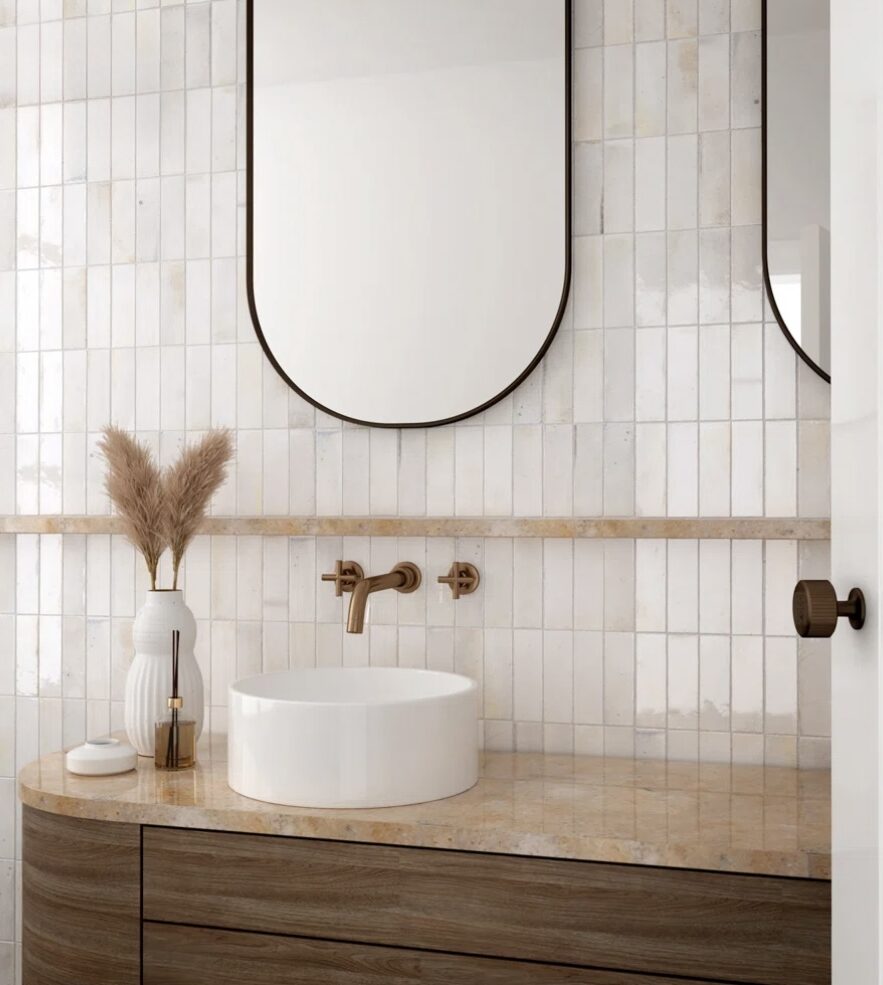
Let’s clear this up right now.
Subway tile is not “having a moment.” It’s not the backsplash equivalent of a makeup trend we will all quietly regret in a few years. It isn’t something we’re going to look back on and say, “What were we thinking?”
Subway tile is a design legend.
It first appeared in the early 1900s in New York City subway stations — and it wasn’t selected because it was beautiful or trendy. It was chosen because it was smart. The glossy ceramic rectangles were durable, sanitary, easy to clean, and highly reflective, brightening underground spaces long before lighting design was a conversation. Function led. Beauty followed. Somehow, more than a century later, we’re still here talking about it.
That’s not an accident.
In classic American farmhouse kitchens, subway tile became almost instinctive. These were homes built for real life — flour on the counters, muddy boots by the door, kids running through the kitchen barefoot. White subway tile felt fresh, wiped clean easily, and quietly supported the utilitarian backbone of the farmhouse aesthetic. It didn’t fight for attention next to apron sinks or butcher block counters. It simply did its job. Bright. Clean. Honest.
Take a step into a Victorian home — rich woodwork, ornate moldings, layered textures — and subway tile shows up again, but for an entirely different reason. Against all that visual drama, it provided breathing room. Sometimes beveled, sometimes strengthened in gem tones, it balanced the complexity of the era without trying to compete with it. Even in a time known for embellishment, restraint had its place. Subway tile understood that. (Occasionally, I wish more people did too!)
Craftsman homes embraced it in yet another way. Here, the emphasis was on quality and intention. Subway tile often appeared in thoughtful layouts — herringbone, vertical stack, basketweave — paired with earthy glazes that echoed the natural palette of the style. It stayed simple, but the way it was laid added character. It proved that interest doesn’t require excess. It requires purpose.
That’s really the heart of it.
What makes subway tile enduring isn’t nostalgia. It’s adaptability. Shift the pattern and the entire mood changes. Go matte instead of glossy. Choose warm white instead of stark white. Take it navy, sage, or charcoal. Pair it with light grout for softness or dark grout for contrast. The tile remains the same at its core — simple, structured, dependable — yet it becomes whatever the space needs it to be.
Trends demand attention. They shout. They push. They fail. They try to convince you they matter.
Legacies don’t.
Subway tile doesn’t date a home. It anchors it — especially in real estate. Buyers may debate cabinet finishes or light fixtures, but subway tile rarely causes hesitation. It feels grounded. Familiar. Safe in the best way. Materials that feel grounded tend to hold their value across generations.
So when someone asks if subway tile is “overdone,” I can’t help but smile a little. Is hardwood flooring overdone? Is natural light overdone? Subway tile has survived more than 100 years of shifting styles — Victorian, Craftsman, Farmhouse, Contemporary — and it continues to show up not because we lack creativity, but because it supports it.
That isn’t luck.
That’s design integrity.
Subway tile isn’t just white rectangles on a wall. It’s proof that timeless design doesn’t need to shout to endure. It just needs to work — and work beautifully.
Subway tile is not a trend.
It’s a design legend.